

Beyond the Similarity Score: How Educators Can Turn Plagiarism Reports into Learning Opportunities
Reading Time: 8 minutesTwo students submit research essays for the same course. Both receive a similarity score of 24%. In the first essay, much of the matching text consists of properly attributed quotations and bibliographic entries. In the second, one of the matches is a paragraph copied from a published article without acknowledgment.
The numbers are identical, but the educational questions are different. Does the first student use quotations selectively and contribute enough original analysis? Does the second understand how to acknowledge another author’s work? What should each student do next?
This hypothetical situation illustrates a limitation of treating similarity reports as scores to be minimized. Used thoughtfully, a report can help educators identify gaps in students’ understanding of sources, guide revision, and make academic integrity a practical part of learning to write.
What a Similarity Report Actually Tells You
Text-matching software compares a submission with the sources available to the system. A report typically identifies overlapping passages and associated sources, while a similarity score summarizes the extent of matching text according to the tool’s calculation and settings. The report does not independently establish whether plagiarism has occurred.
As Turnitin’s explanation of similarity scores makes clear, correctly attributed material can appear among the matches. A low score can also coexist with a substantial attribution problem in a single important passage. Sources outside the system’s coverage, borrowed ideas expressed in different words, and other forms of misconduct may not produce an identifiable text match.
Interpret results in light of the assignment, available sources, and report settings. A literature review, laboratory report, and reflective essay do not necessarily have comparable patterns of similarity. Institutional thresholds may help prioritize work for review, but the percentage cannot establish misconduct or a student’s intent by itself.
For an illustration of how matched passages and sources are presented in a particular reporting interface, educators can consult PlagiarismSearch’s guide to interpreting similarity reports. The labels and settings of individual tools may differ; the educator’s task remains to interpret the evidence in context.
Why Treating Similarity Scores as Grades Can Mislead Educators
When an assignment is framed around reaching a particular percentage, the student may come to see the report as a numerical obstacle rather than information about writing. Three problems deserve attention.
- The assignment’s purpose gets lost. An essay analyzing primary sources may require direct quotations, while a technical report may use standard terminology. The appropriate use of sources depends on the learning objectives.
- The score replaces the writing criteria. A paper can have few matches and still contain weak attribution, unsupported claims, or little independent reasoning. Correctly attributed quotations can contribute to a higher score without constituting plagiarism.
- Revision becomes cosmetic. If the only instruction is to lower a number, students may focus on replacing words instead of understanding the source and developing their own argument.
Research does not justify treating software as a complete solution to academic misconduct. A 2021 scoping review by Hayden and colleagues included 129 articles on text-matching software in higher education. The authors found the evidence about its effectiveness in reducing plagiarism inconclusive. A formative approach is a way to organize teaching and feedback, not a guarantee that misconduct will decrease.
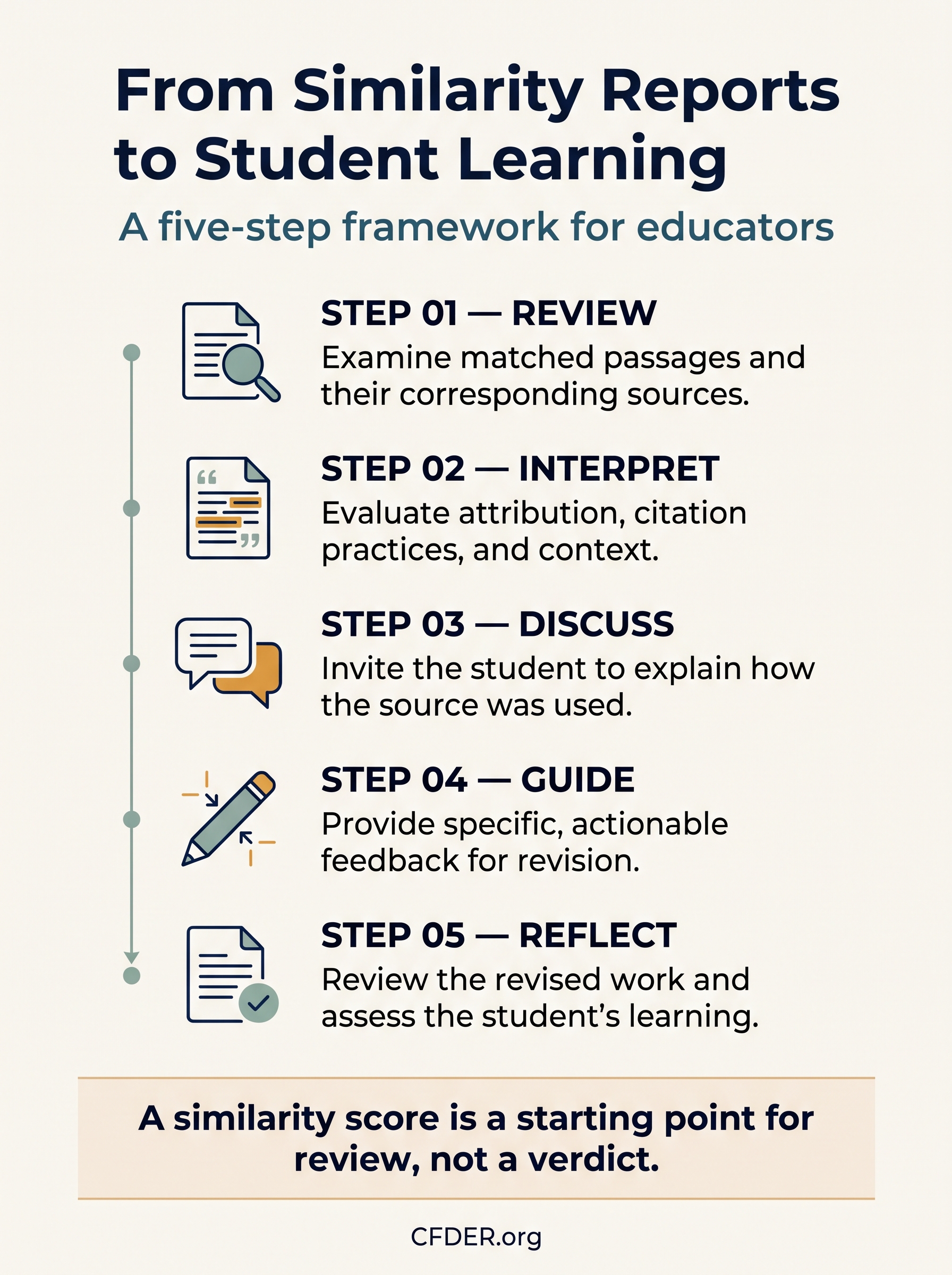
A Five-Step Framework for Reviewing Similarity Reports
The following framework is a practical teaching proposal. It is not a validated assessment instrument, a product workflow, or a substitute for institutional academic integrity procedures.
1. Review: Start with the passages
Open the report and inspect the matches that matter most to the assignment. Begin with substantial or concentrated overlaps and passages central to the student’s argument. Where accessible, compare the text with the indicated source and its surrounding context. A lengthy matching passage may merit closer attention than many isolated conventional phrases.
2. Interpret: Examine attribution and context
Determine whether the student has quoted, paraphrased, or otherwise used the material. Check whether the boundaries of the borrowing are clear and whether the attribution follows the required conventions. Ask how the passage contributes to the student’s argument. If the source cannot be examined, note the uncertainty rather than assuming what the match means.
3. Discuss: Invite an explanation
Where the course and institutional procedures allow, ask the student to describe how the passage was developed. A useful starting question is, “What role does this source play in your argument?” The discussion can clarify how the student understands the distinction between their own contribution and another author’s ideas. Avoid treating difficulty explaining a passage as proof of misconduct. When a formal concern arises, follow the applicable process rather than conducting an informal investigation in its place.
4. Guide: Give a specific revision task
Identify the skill the student should practice and the next action to take. Instead of asking for an entire paper to be rewritten, direct attention to a passage or a pattern of problems. CFDER’s guide to writing focused feedback notes offers a useful complement to this approach.
5. Reflect: Assess what the student learned
When revision is permitted, compare the original passage with the revised one and ask the student to explain the changes. Look for improved attribution, appropriate quotation or paraphrasing, and a clearer independent contribution. If a new report is generated, use it as additional information rather than the sole measure of improvement.
Four Similarity Report Scenarios and How to Respond
The following scenarios and sample passages are fictional teaching examples. They are not actual student submissions or results from a particular software product. Whether a revision or a formal referral is appropriate depends on the assignment and institutional rules.
Scenario 1: High similarity with proper attribution
Situation. A history student submits an essay that draws heavily on excerpts from primary documents. The quotations are identified and cited, and the bibliography contributes additional matches.
What to check. Confirm that quotations are accurately reproduced, clearly marked, and appropriately attributed. Review whether the assignment calls for extensive quotation and whether the student has provided sufficient interpretation of the evidence.
Possible feedback. “Your quotations are clearly identified. Choose one of the longer excerpts and explain how it supports your interpretation. If only part of it is necessary, quote that part and use the remaining space for your analysis.”
Learning goal. Select evidence purposefully and distinguish the student’s own reasoning from the source material.
Scenario 2: Low similarity with a substantial attribution problem
Situation. An economics essay contains relatively few matches. One of them, however, is a paragraph presenting a published explanation as if it were the student’s own.
What to check. Examine the original publication, the extent of the overlap, any surrounding attribution, and the significance of the borrowed passage. Do not dismiss the concern because the overall score is low. Follow the institution’s procedure if the findings warrant it.
Possible feedback, where revision is appropriate. “Compare this paragraph with the identified source. Mark any exact borrowed wording and attribute the ideas. Then explain the argument in relation to your own essay.”
Learning goal. Recognize when another person’s work must be acknowledged, regardless of the proportion of matching text.
Scenario 3: A citation is present, but the paraphrase is too close
Situation. A student cites a source but changes only a few words from the original.
Illustrative source passage: “Frequent opportunities to retrieve information can help learners recognize which concepts they understand and which require further practice.”
Illustrative student version: “Regular opportunities to retrieve information can help students identify which concepts they understand and which need further practice” (Source A).
Both passages were created for this example; Source A is a placeholder, not a real publication. The citation acknowledges the origin of the idea, but the second passage retains much of the original wording and structure without quotation marks.
What to check. Consider whether the student is using distinctive language or unavoidable technical vocabulary, whether exact wording should be quoted, and whether the paraphrase accurately represents the source.
Possible feedback. “You have acknowledged the source. Now set it aside, explain the idea from your understanding, and connect it to your argument. Reopen the source to check accuracy and retain the citation. If the original wording is necessary, use a properly marked quotation instead.”
Learning goal. Understand paraphrasing as a process of comprehension and accurate restatement, not synonym replacement.
Scenario 4: A match to the student’s own previous work
Situation. A report highlights passages that match an earlier paper submitted by the same student.
What to check. Establish whether the match is to an authorized earlier draft of the current assignment, a previous assessed submission, or another permitted use of the student’s work. Review the assignment’s reuse rules and, where appropriate, the system’s repository settings. A match alone does not establish unauthorized reuse.
Possible feedback. “This passage appears in your earlier work. Let’s establish which assignment it comes from and whether reuse is permitted here. If the current task requires new work, identify the new analysis you need to develop.”
Learning goal. Distinguish permitted revision and transparent reuse from submitting previously assessed work contrary to course requirements.
What Constructive Feedback Sounds Like
Useful feedback names an observable issue, connects it to a writing skill, and describes an achievable next step. These examples are designed for a formative setting, not as replacements for official notifications when misconduct procedures apply.
| Instead of | Try |
|---|---|
| Your similarity score is too high. | Review these two highlighted passages and explain how each source supports your argument. |
| Reduce the percentage. | Revise this paragraph so the borrowed ideas are clearly attributed and your own analysis is visible. |
| This paragraph is plagiarized. | This passage closely matches the source. Let’s examine how it was incorporated into your work. |
| Rewrite everything. | Focus on this section first. Identify where quotations, paraphrases, and citations are needed. |
Students can also be asked to annotate one passage themselves: identify its source, explain how the source is used, and propose a revision. The annotation gives the educator evidence of the student’s understanding that a percentage cannot provide.
Integrating Similarity Reports into the Writing Process
Formative use works best as an intentional part of the assignment rather than an unexpected check at the end. The University of Waterloo’s teaching guidance describes ways to integrate text matching into learning activities around quotation, citation, and paraphrasing. The University of Iowa’s teaching guidance similarly emphasizes explaining the process and structuring draft assignments carefully.
- Before submission: Explain the purpose of text matching, the applicable integrity policy, and the assignment’s expectations for source use. Demonstrate a sample report without exposing private student work.
- At the draft stage: Where permitted, offer a low-stakes opportunity to review a draft. Establish who can see reports and whether draft submissions will be retained or compared with later versions.
- During feedback: Focus on a manageable number of meaningful passages or recurring problems. Provide a concrete example of the required writing skill.
- During revision: Ask students to apply the feedback independently and briefly explain the reasoning behind their changes.
- At final submission: Evaluate the work against the assignment criteria and follow the institution’s academic integrity procedures when concerns remain.
Use institutionally authorized systems and follow applicable privacy, accessibility, retention, and student-notification requirements. Avoid uploading students’ work to additional external services without appropriate authorization. Where repository settings allow, plan draft handling in advance so that permitted revisions are not misinterpreted as unauthorized reuse. Apply review criteria consistently rather than singling out students based on assumptions.
Evaluating Progress Beyond the Similarity Score
To assess whether a student has developed stronger source-use skills, compare the writing and the student’s explanation of the changes. The following criteria can be incorporated into an existing assignment rubric or used as prompts during a revision conference.
- Attribution: Are borrowed ideas and exact wording acknowledged where required?
- Accuracy: Does the writing represent source claims faithfully?
- Quotation and paraphrasing: Are direct quotations clearly distinguished from restated ideas?
- Integration: Does the evidence contribute to a coherent argument or interpretation?
- Reflection: Can the student explain what changed and why?
A lower score may accompany better writing, but it is not a required outcome. Adding a well-chosen, correctly quoted passage can increase similarity while improving the argument. Conversely, replacing individual words without addressing attribution can reduce visible overlap without resolving the underlying issue.
A Practical Checklist for Educators
- Have I reviewed relevant matches and their available sources rather than just the score?
- Have I considered the assignment’s purpose and the report’s settings?
- Have I distinguished correctly attributed material from potential attribution problems?
- Have I considered whether matches relate to an authorized draft or other permitted reuse?
- Have I recorded uncertainty and avoided inferring intent from a match alone?
- Have I followed institutional procedures where an integrity concern requires formal review?
- Where revision is permitted, have I given specific, actionable guidance?
- Have I evaluated the student’s learning and writing quality rather than rewarding a lower score alone?
Conclusion
A similarity report is most useful when it informs professional judgment rather than replacing it. It can point an educator toward passages that deserve attention, help identify teachable moments, and provide a focus for a discussion about responsible writing. The educator’s role is to examine the evidence fairly, follow institutional procedures, and, where appropriate, help the student develop skills that carry into future assignments.
The aim is not a paper with no matching text. It is a paper in which sources are used accurately, transparently, and purposefully, and in which the student’s own contribution is clear.
References and Further Reading
- Hayden, K. A., Eaton, S. E., Pethrick, H., Crossman, K., Lenart, B. A., & Penaluna, L.-A. (2021). A Scoping Review of Text-Matching Software Used for Student Academic Integrity in Higher Education. Education Research International, Article 4834860. DOI: 10.1155/2021/4834860.
- University of Waterloo, Centre for Teaching Excellence. Using Turnitin in Your Courses.
- University of Iowa, Office of Teaching, Learning, and Technology. Turnitin Teaching Best Practices.
- Turnitin. Understanding the Similarity Score.